Array Tomography with ZEISS Scanning Electron Microscopes

Reduce your time to result with automated nano-imaging of large samples: image your serial sections fast and efficiently

24 Apr 2016

Lois Manton-O'Byrne, PhD
Executive Editor

Industry news


ZEISS Microscopy and RMC-Boeckeler recently organized customer workshops on the topic of array tomography. The workshops in Germany and Australia, hosted by the ZEISS Microscopy Labs in Munich and the Centre for Advanced Microscopy in Canberra highlighted the growing interest into high throughput 3D electron microscopy approaches for life sciences. With array tomography solutions such as ATUMtome with Atlas 5 and ZEISS FE-SEM instruments or the unique ZEISS MultiSEM 505, the world’s fastest scanning electron microscope, ZEISS enables industry and research with the fastest automated imaging throughput at highest resolutions.
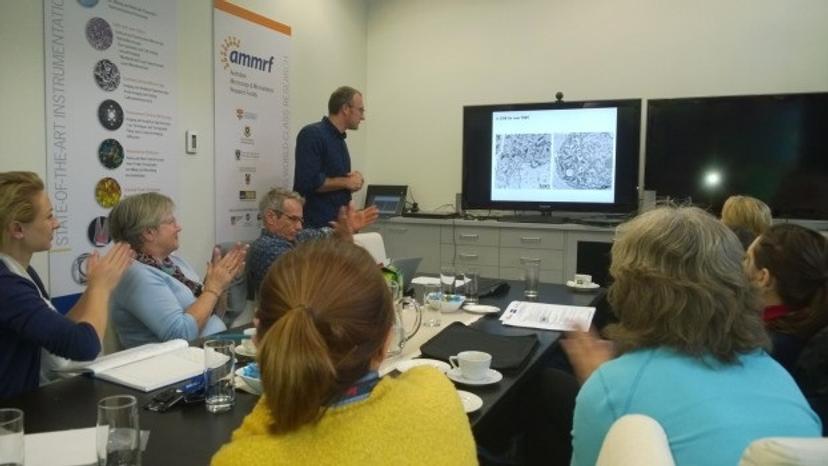
ZEISS & RMC-Boeckeler Array Tomography Workshop in Canberra

Scanning electron microscopy is capable of imaging biological microstructures at amazing resolution and can be combined with 3D imaging to provide further insight. Various techniques can be employed to image samples in 3D, many of which have only recently become accessible to the research community. The fully booked workshops provided an overview of recent strides in instrumentation development. These advances have the potential to do for electron microscopy what confocal microscopy did for light microscopy.

ZEISS & RMC-Boeckeler Workshop in the ZEISS Microscopy Labs, Munich

In his presentation Trevor Hinwood (Distributor for RMC) explored sample preparation techniques for the use of scanning electron microscopy in back scatter electron detection mode which produces images quite equivalent to TEM images at magnifications up to 10,000x. Steve Pfeiffer (RMC-Boeckeler) presented 3D methods including serial block face SEM (3View, SBFSEM), focused ion beam (FIB-SEM) and the automatic tape-collecting microtome (ATUMtome). All of these techniques have the capability of producing thousands of images or sections in serial order. Terence Da Silva (ZEISS Microscopy) introduced ZEISS Atlas 5 Array Tomography with an automated approach to image acquisition and data collection. The workshop participants Eric Hannsen (University of Melbourne) and Rick Webb (University of Queensland) presented work done with their current imaging systems, also highlighting the future potential of these technologies.
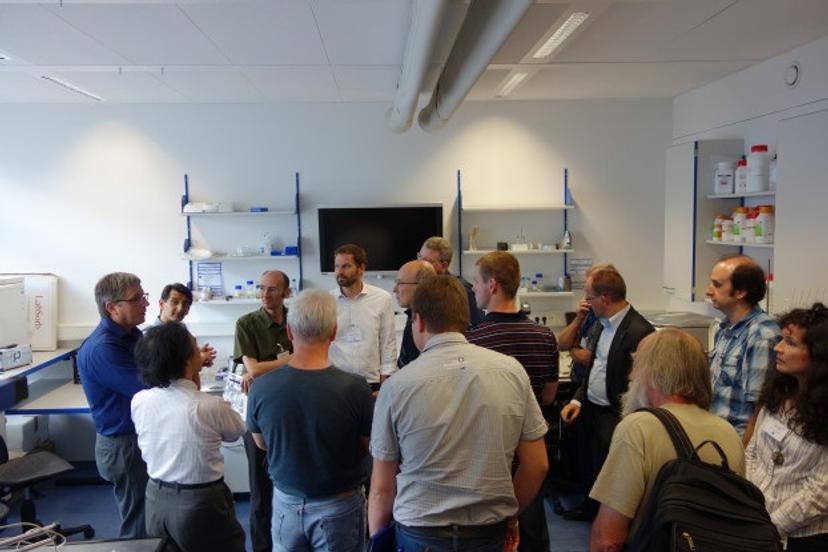
Richard Schalek (Harvard), co-inventor of the ATUMtome, at the ZEISS Microscopy Labs Munich

“It was a great opportunity to exchange ideas and experiences on sample preparation and 3D imaging of biological samples in SEM”, said Melanie Rug, manager of the Center for Advanced Microscopy (CAM) and host of the event. Similar joint workshops between ZEISS and RMC-Boeckler were held at the ZEISS Microscopy Labs in Munich with key speakers such as Richard Schalek (Harvard) and Christel Genoud (FMI, Basel).
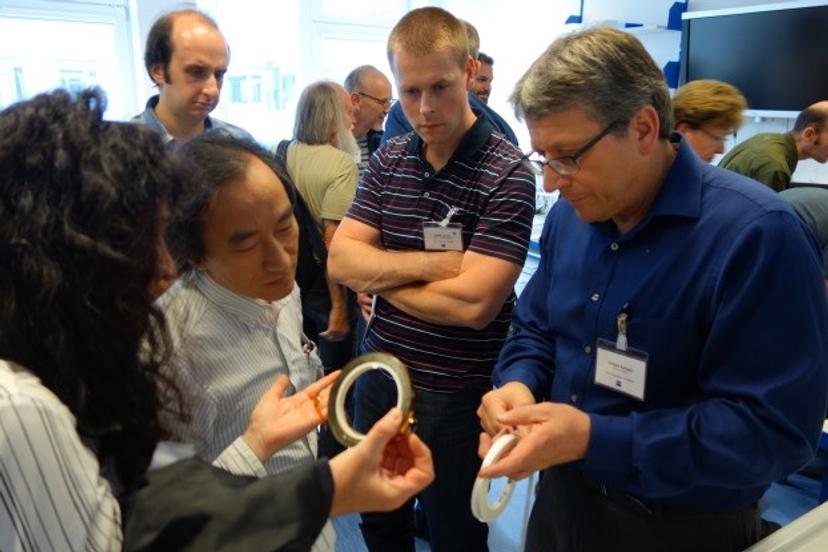
Taking a closer look at the tape collecting workflow for array tomography

“The workshop in Canberra was a direct transfer of the successful concept to our local customer community and a great collaboration between CAM, RMC-Boeckler and ZEISS” said Rene Hessling, Head of the Microscopy Division for ZEISS Australasia.

Links

Tags

Sample PreparationSample preparation can improve the quality and speed of separation techniques. Products to assist sample preparation include filtration equipment, evaporators, membranes and sieves.Light MicroscopyLight microscopes or optical microscopes are used to visualize microscale objects under magnification, including cells, clinical specimens and materials. Lab equipment for light microscopy includes confocal microscopes, fluorescence microscopes, zoom and stereo microscopes. Microscope slides and imaging reagents are available for visualizing samples, as well as various microscope stages and incubators for large or temperature-sensitive samples. Find the best light microscopes in our peer-reviewed product directory: compare products, check customer reviews and receive pricing direct from manufacturers.Electron MicroscopyElectron microscopes (EM) are used to create high-resolution images of samples at the nanoscale by means of an accelerated beam of electrons as a source of illumination. Types of electron microscope include scanning electron microscopes (SEM), transmission electron microscopes (TEM), scanning transmission electron microscopes (STEM) and cryo-electron microscopes. Focused ion beam (FIB) microscopes are useful for modifying or milling a sample surface with nanometer precision, as well as imaging. Find the best electron microscopes in our peer-reviewed product directory: compare products, check customer reviews and receive pricing direct from manufacturers.AutomationAutomation in laboratories and manufacturing processes enhances efficiency, precision, and scalability by reducing the need for manual intervention. It plays a critical role in improving productivity, minimizing human error, and accelerating workflows in fields like diagnostics, drug development, and industrial testing. Automation technologies include robotic systems, automated liquid handlers, and process control systems that streamline complex tasks and ensure consistent, reproducible results. Explore our peer-reviewed product directory to discover the best automation solutions, compare options, read user reviews, and get prices directly from manufacturers.ImagingImaging techniques are essential for obtaining visual representations of samples to understand structures, processes, and function in biological, chemical, and physical research. These tools range from traditional light microscopy to advanced imaging modalities like MRI and electron microscopy, providing researchers with valuable data for diagnostics, drug discovery, and material analysis. Explore imaging solutions in our peer-reviewed product directory to compare products, check reviews, and get pricing directly from manufacturers.MicroscopyMicroscopy is a technique used to observe small objects in detail, from cells to materials, using light or electron microscopes. It enables researchers to examine structures with high resolution, aiding in fields such as biology, medicine, and materials science. With advanced microscopy techniques, scientists can gain insights into cellular processes, tissue structures, and material properties. Explore the best microscopy solutions in our peer-reviewed product directory, compare products, read customer reviews, and get pricing directly from manufacturers.SEMScanning Electron Microscopy (SEM) is a technique that uses a focused electron beam to scan a sample and create high-resolution images. It is widely used in materials science, nanotechnology, and biological research. Explore SEM systems in our peer-reviewed product directory; compare products, check reviews, and get pricing directly from manufacturers.EMBL3DCorrelative Microscopy