
Antibacterial/antiviral property given to every object
Researchers at KIMS develop functional antibacterial/antiviral additive
16 Feb 2022
Industry news
A research team led by Dr. Chang Su Kim at the Department of Nano-Bio Convergence of the Korea Institute of Materials Science (KIMS) succeeded in developing a material that gives antibacterial/antiviral properties without changing the physical properties of various products that are commonly used. KIMS is a government-funded research institute under the Ministry of Science and ICT.
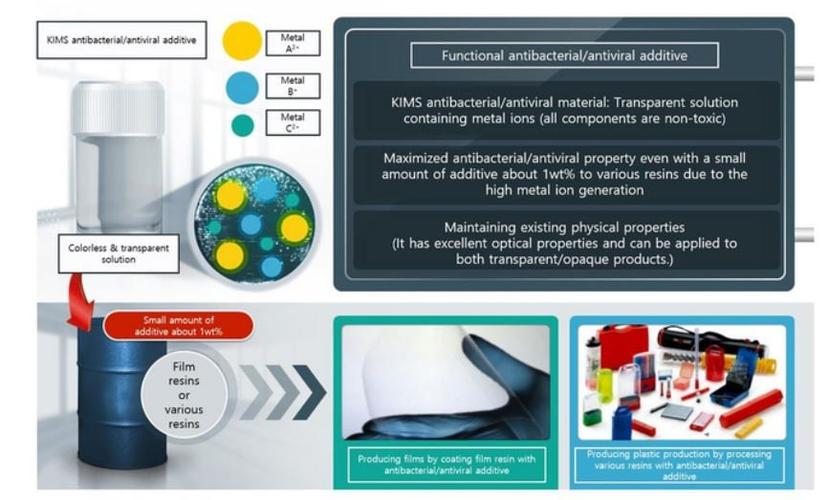
Currently, antibacterial films and antibacterial coating products are widely used for elevator buttons, door handles, and touch screens. However, it is difficult to maintain the long-term antibacterial durability of the material because of the low transparency and it can be easily damaged due to frequent use. In addition, it requires an additional process of attaching or producing a film to an existing product.
The research team at KIMS developed an antibacterial/antiviral additive that generates high metal ions. By simply adding a small amount of additive about 1-2 weight percent (wt%) to various resins, the antibacterial properties are increased to 99.99%, and the antiviral properties are more than 10 times in 2 hours without changing optical/mechanical/thermal properties of existing products. Because this material is used as an additive, it is possible to carry out ultraviolet (UV) and heat curing process without additional processing on existing products. In addition, the antibacterial/antiviral additive is composed of non-toxic substances without organic antibacterial agents and nano compounds.
Dr. Chang Su Kim, the lead researcher of the team, said, “This technology can be widely applied to display films, functional textiles, home appliances/furniture films, window films, interior and exterior materials for automobiles, kitchen/bathroom/sanitary products, and medical supplies. We are conducting mass-production tests together with some companies who would use the material. We will spare no effort to tackle new infectious diseases for the post-COVID-19 era when people's interest in personal hygiene will greatly increase.”
Jung-hwan Lee, the President of KIMS, said, “KIMS will continue to discover excellent ideas that have commercial potential and make efforts to materialize and commercialize rapidly from the market point of view. We will do our best to support and encourage the researchers so that we can localize the functional antibacterial/antiviral materials and enter the overseas markets.”
This research achievement was funded by the Ministry of Science and ICT and supported by the Fundamental Research Program of KIMS. The research team is currently working on commercializing the technology by promoting the establishment of a research institute spin-off company.
Want the latest science news straight to your inbox? Become a SelectScience member for free today>>