
Analytik Reports on the Use of the CPS Instruments Disc Centrifuge System for Nanoparticle Characterization
6 Nov 2012Product news
The Surface and Nanoanalysis research group at the National Physical Laboratory (NPL) studies the physical and chemical properties of surfaces and nanomaterials, including biological samples and electronic components. NPL supplies a range of measurement services, reference materials, and software, which underpin quantitative surface analysis. Among the measurement services offered is nanoparticle sizing for which a suite of particle sizing techniques are employed.
One of the techniques used is Differential Centrifugal Sedimentation or DCS. DCS is used to obtain ultra-high resolution size distributions of particles in the nano- and micron- range. The size range of the particles that can be analyzed by DCS depends on the density of their constituent materials.
Group member Nia Bell describes how she uses DCS. "We have used DCS to size particles and check for aggregation. We have also combined the density dependent information from DCS to density independent information from other techniques to investigate particle porosity and the fictionalization of particle surfaces. I have looked at silica and gold particles while other members of the group have looked at cerium oxide, titanium dioxide and zinc oxide particles amongst others."
Bell then continued to describe the density measurements in more detail: "DCS was used to investigate the adsorption of protein on gold nanoparticles. With increasing protein shell thickness the effective density of the particles decreased. For accurate interpretation of the DCS data this variable effective density had to be considered. Either the density of the shell was assumed to be equal to some constant value and the shell thickness extracted from the DCS data, or the shell thickness was assumed to be that measured using a density independent technique and DCS used to calculate the density of the shell. From the density and thickness of the protein shell, the amount of protein adsorbed could be estimated."
Other particle sizing techniques used in the laboratory include Dynamic Light Scattering, DLS, and Nanoparticle Tracking Analysis, NTA. Bell explains how they are used: "In the past DLS was the standard technique for most solution based particle sizing measurements, however, with the advent of DCS and NTA we are able to tailor our measurements better to individual samples. DCS is normally at least as quick as NTA and DLS so it is used routinely."
The CPS Instrument performs nanoparticle size analysis utilizing the Differential Centrifugal Sedimentation method. This offers the unique ability to resolve very close multimodal particle distributions and to distinguish extremely small shifts in particle size. Rather than using a predictive algorithm, the instrument physically separates the nanoparticles and then measures them as they pass a light source detector and thus provides full characterization in real time.
Related products
Request Quote for All Products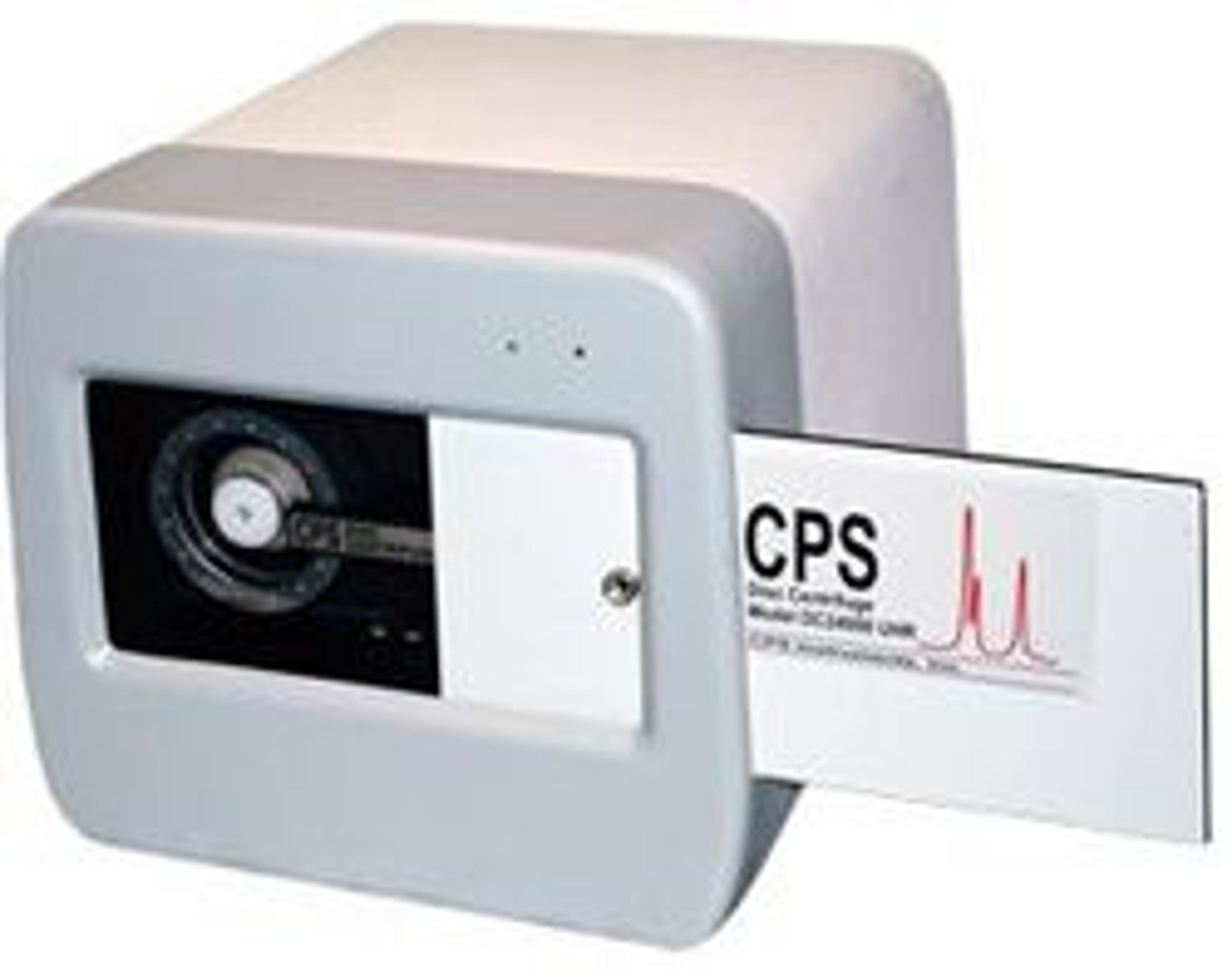
CPS Disc Centrifuge UHR Nanoparticle Size Analyser
Analytik LtdCPS DC24000 UHR nanoparticle size analyser is an effective analytical tool for ultra high resolution, high accuracy measurement of particle size distribution. Highly poly-dispersed particles can be measured in the size range of ~2.0nm to ~75 microns, at 2 to 10 times better resolution than any other particle sizing instrument, regardless of measurement technique.Utilising Differential Centrifugal Sedimentation (DCS), the CPS Disc Centrifuge UHR offers the unique ability to resolve very close multimodal particle distributions and to distinguish extremely small shifts in particle size. Rather than using a predictive algorithm, the instrument physically separates the nanoparticles and then measures them as they pass a light source detector - providing full characterisation in real time.CPS Disc Centrifuge UHR Nanoparticle Size Analyser Features: Ultra high resolution with clean separation of narrow peaks that differ in size by as little as 2% Able to detect and measure very small and subtle changes / differences in particle size Able to measure / monitor nanoparticle coating thickness Very high sensitivity; minimum detection limit below 10-8 gram active sample for narrow peaks Highly reproducible results Dynamic range capability >1000 for measurement of broad and multimodal distributions Measurement of particles of virtually any density Wide range of data presentation options, including multiple distribution overlays