An Alternative to Mercury Vapor Lamps
31 Jan 2017
Product news
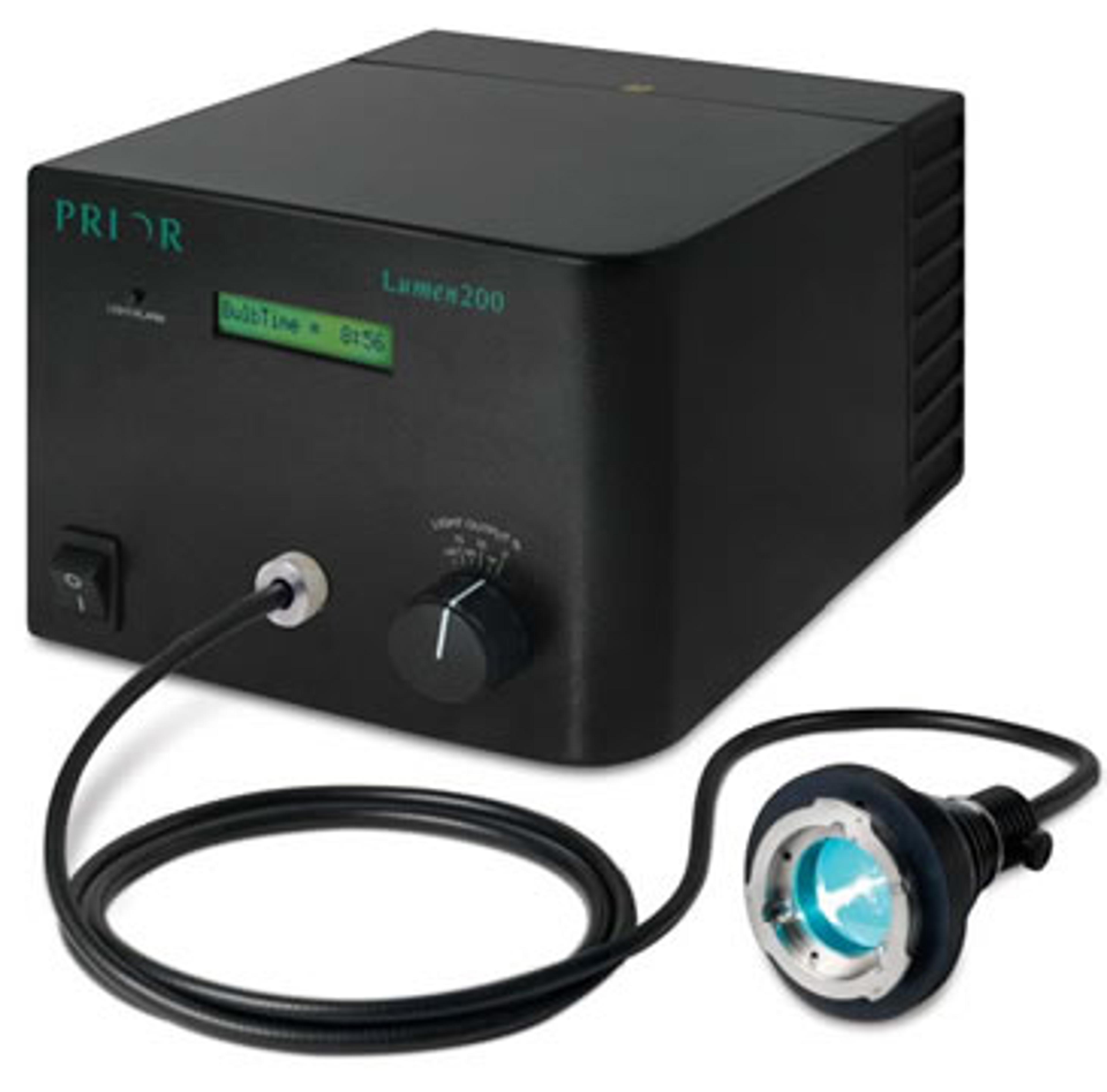
The Lumen 200 Fluorescence Illumination System from Prior Scientific offers a powerful, cost effective alternative to traditional short arc Mercury vapor lamps and bulbs used in fluorescence microscopy.
Mercury vapor lamps and bulbs suffer from a number of limiting disadvantages including an operational lifetime rarely exceeding 200 hours and the need for time consuming alignment procedures during installation. In addition, Mercury vapor bulbs are susceptible to flickering, limiting the use of these light sources in quantitative fluorescent microscopy. Despite this, Mercury vapor lamps and bulbs are still regarded as an excellent illumination source for many fluorophores, even when the dyes are present in low concentrations.
Many microscopists, whilst recognizing the disadvantages of Mercury vapor lamps and bulbs, worry that replacing it with another light source could affect the excitation of their fluorophores, and may require a replacement of filters which could prove both time consuming and costly. The Lumen 200 fluorescence illumination system from Prior Scientific is proven to offer a superior alternative to a mercury vapor lamp or bulb whilst retaining the spectral quality offered by these traditional microscopy light sources.
Using a metal halide lamp rather than the more traditional high pressure mercury or xenon burners, the Lumen 200 delivers 2000 hours of stable output compared to a maximum of 200 hours for a mercury vapor lamp or bulb. Coupled to a microscope using a liquid light guide there is very little heat transfer helping to eliminate thermal drift during time lapse experiments. The Lumen 200 also incorporates a variable light attenuation control to reduce the potential of bleaching and phototoxicity.
With an effective lifespan of 2000 hours, light source replacements are needed less frequently. A built-in display clearly indicates how much time your current Lumen 200 light source has left and alerts you when it needs replacing. No time-consuming alignment procedures are required when replacing the light source, thanks to its self-aligning design and to the Lumen 200 liquid light guide that homogenizes the light.
The spectrum of the Lumen 200 is similar to that of a traditional Mercury vapor lamp or bulb, ensuring that the quality and characteristics of the excitation light is maintained and that no costly filter changes are required. Compatible with most commercially available upright and inverted research microscopes, the Lumen 200 is an excellent choice for a great value, efficient and superior replacement for a traditional Mercury vapor lamp or bulb light source.