Agilent Technologies Introduces New Atomic Spectroscopy Platform for Multiple Analytical Applications

Instrument delivers greater speed and precision than any other ICP-OES system

5 Jun 2016
Weylan Kiam-Laine
Microbiologist

Product news

Agilent Technologies Inc. introduces a new addition to its lineup of inductively coupled plasma-optical emission spectrometers. The Agilent 5110 ICP-OES will enable scientists to perform faster, more precise ICP-OES analysis than ever before in food, environmental and pharmaceutical testing as well as for mining and industrial applications.

The new system builds on the company’s breakthrough 5100 ICP-OES, which captures axial and radial views of plasma in a single measurement, enabling laboratories to use half as much argon in the process, saving both time and money. The new system is also a dual-view system.

Unlike ICP-OES systems from other vendors, the 5110 enables laboratories to increase throughput without compromising on precision.

“The Agilent 5100 revolutionized the ICP-OES market, delivering significant value in terms of cost of ownership, performance, and ease of use,” said Philip Binns, Agilent's vice president of spectroscopy products. “The new Agilent 5110 extends that revolution with more cutting-edge innovations.”

The 5110 includes three advances:

  • A fully integrated Advanced Valve System with unique hardware and software technologies that enable ultra-high throughput with excellent precision and ease of use.
  • IntelliQuant measurement for rapid sample screening and simple method development.
  • New diagnostic capabilities that maximize instrument uptime and simplify troubleshooting.

“With the introduction of the 5110 ICP-OES we continue to lead the way in elemental analysis innovation,” said Binns. “Our atomic spectroscopy portfolio offers the most diverse application coverage for AA, ICP-OES, and ICP-MS, while our unique MP-AES and ICP-QQQ technologies help customers redefine the way they work.”

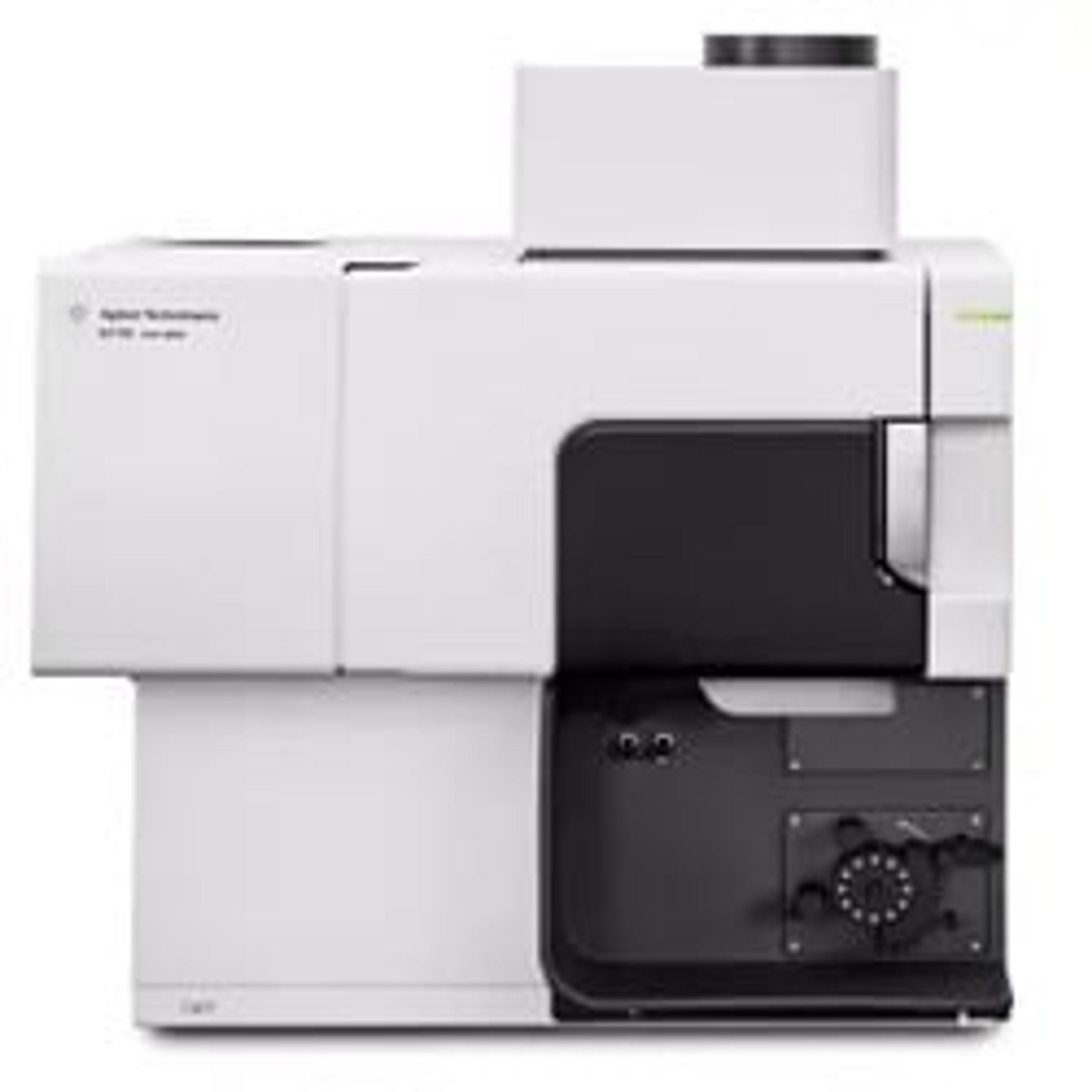
5110 ICP-OES

Agilent Technologies

The Agilent 5110 ICP-OES Instrument features unique Dichroic Spectral Combiner (DSC) technology that enables synchronous radial and axial measurements.

(18)

Links

Tags

Atomic Absorption / Emission SpectroscopyAtomic absorption spectroscopy (AAS) and atomic emission spectroscopy (AES) — also called optical emission spectroscopy (OES) — are used to detect the elemental constituents in samples. Both techniques involve the atomization of a sample. Atomic absorption spectrometers may use a flame or furnace to create an atomic vapor of the sample before irradiation with spectral light. Optical emission spectrometers may use a flame, inductively coupled plasma (ICP), microwave plasma (MP) or spark arcs to atomize and excite the sample. At higher excitation energies, electrons can be emitted instead of photons, which can be useful for samples that can’t be atomized and for surface analysis. Explore electron spectroscopy equipment such as Auger spectrometers and photoelectron spectrometers for surface elemental analysis of samples. Find the best atomic absorption, photoelectron and optical emission spectrometers in our peer-reviewed product directory: compare products, check customer reviews and receive pricing direct from manufacturers.Mass SpectrometryMass spectrometry (MS) is a powerful analytical technique used to identify and quantify molecules based on the mass-to-charge ratio of gas-phase ions. It provides detailed information about the structure, composition, and properties of compounds and is widely used across fields such as environmental monitoring, materials science, drug discovery and development, food and beverage testing, and wider chemical research. Key MS techniques include tandem mass spectrometry (MS/MS), liquid chromatography–mass spectrometry (LS-MS) and inductively coupled plasma (ICP-MS). Choosing from these wide range of techniques and technologies can be a daunting task, so keep up to date with scientific applications, performance expectations, and customer reviews here all in one place. Visit our product directory to receive quotes direct from the manufacturer. High ThroughputHigh throughput experiments allow the simultaneous processing of several samples. This parallelization reduces the cost per experiment and increases reproducibility and output volume of data.ICP-MSInductively Coupled Plasma Mass Spectrometry (ICP-MS) is a powerful analytical technique used to determine the concentrations of elements and their isotopes in a variety of samples, including water, soil, and biological tissues. It involves ionizing elements in the samples with extremely high-temperature Argon (Ar) plasma and then using a mass spectrometer to measure the number of ions based on their mass-to-charge ratio (m/z). Explore ICP-MS systems in our peer-reviewed product directory; compare products, check reviews, and get pricing directly from manufacturers.Elemental AnalysisElemental analysis involves determining the elemental composition of a sample, often used in environmental, pharmaceutical, and material sciences. Techniques like ICP-MS, X-ray fluorescence, and atomic absorption spectroscopy allow precise quantification of elements such as metals and nonmetals in complex matrices. Browse our peer-reviewed product directory to find the best elemental analysis tools, compare products, check reviews, and get pricing directly from manufacturers.SpectroscopySpectroscopy is a technique that analyzes the interaction of light with matter to study molecular properties, concentrations, and structural information. Widely used in chemical, pharmaceutical, and environmental analysis, spectroscopy offers insights into molecular composition and helps identify unknown compounds. It plays a key role in quality control, research, and diagnostics. Browse our peer-reviewed product directory to compare spectroscopy tools, read reviews, and get prices directly from manufacturers.Plasma