
Adapting Existing Technologies to Develop Custom Applications and Solutions at a Core Genomics Facility
Learn about advanced sequencing applications at the Wellcome Trust Centre for Human Genetics
21 Mar 2017Editorial article

A snapshot of the video from Labcyte Genomics Symposium 2016

Wellcome Trust Centre for Human Genetics Wellcome Trust Centre for Human Genetics is a research institute of the Nuffield Department of Medicine at the University of Oxford, funded by the University, the Wellcome Trust and numerous other sponsors.
Dr. Paolo Piazza, section leader for Library Prep and Process Improvement at the Wellcome Trust Centre for Human Genetics, at the Oxford Genomics Centre, spoke at the Labcyte Genomics Symposium about automated solutions for sequencing facilities.
The Wellcome Trust Centre for Human Genetics is a core facility that provides a high-throughput genomics and bioinformatics service. The Oxford Genomics Centre provides access to research and development capabilities with expertise in three main areas: arrays (genotyping and expression analysis), single cell genomics and Illumina sequencing; it is in this last area of application that Dr. Piazza’s section develops custom workflows and solutions.
In this video presentation, Dr. Piazza presents a selection of the technologies and workflows adapted for various sequencing library applications, with examples of challenges and improvements.
The group undertakes a wide range of low throughput, custom projects for customers and specializes in adapting existing technologies to find solutions, mainly using Illumina sequencing. Dr. Piazza illustrates the diversity of his section’s work with a number of different applications they have worked on involving pathogen resequencing, such as adapting a protocol to detect and sequence full viral genomes. More recently, an additional module to capture pathogen reads has enriched the sequencing data, reducing the number of reads required, minimizing costs whilst providing an alternative to accurately determining viral loads in clinical samples.
A further example is described, showing how the team quickly implements new and promising technologies. In this case, developing a process to detect and evaluate C. difficile on a clinical ward that can deliver data within 1 week rather than several months.
Using newer sequencing technologies
Dr. Piazza also provides an overview of newer sequencing technologies he has been using, such as Oxford Nanopore sequencing, “an exciting technology which allows you to do long reads comparable to Pacific Bio, but instead of large platform, it is smaller and more portable”. Dr. Piazza has been using this technology to support methods for rapid detection of antibiotic resistant pathogens. (Bradley et al., Nature communications 2015). Standardization of workflows in the Library Prep and Process Improvement group is also described, with summaries of the common points and processes for sample QC and library preparation.
Finally, Dr. Piazza reveals how automated liquid handling using the Labcyte Echo 525, has been successfully integrated into these standard workflows. Dr. Piazza is now looking at streamlining library preparation methods to reduce the number of offline steps, initially focusing on the final clean-up step before PCR amplification. PCR amplification here is typically required for pathogen detection applications, which require lengthy culturing steps to generate enough DNA for preparation. Removing the clean-up step would speed up the workflow and also prevent any loss of DNA. Progress has been made to replace final clean-up with a heat inactivation step whilst maintaining the number and quality of sequencing reads possible from libraries. Efforts have also been made to replace DNA fragmentation using an offline sonication with enzyme fragmentation. Data from both of these approaches are presented and the merits of various library kits are discussed, with regard to their ability to produce workflow improvements.
Watch the full presentation or learn more about the Echo® 555 Liquid Handler
Leave a product review today to be entered into a prize draw for the chance to win an iPad or $400 Amazon voucher (or equivalent currency)
Related products
Request Quote for All Products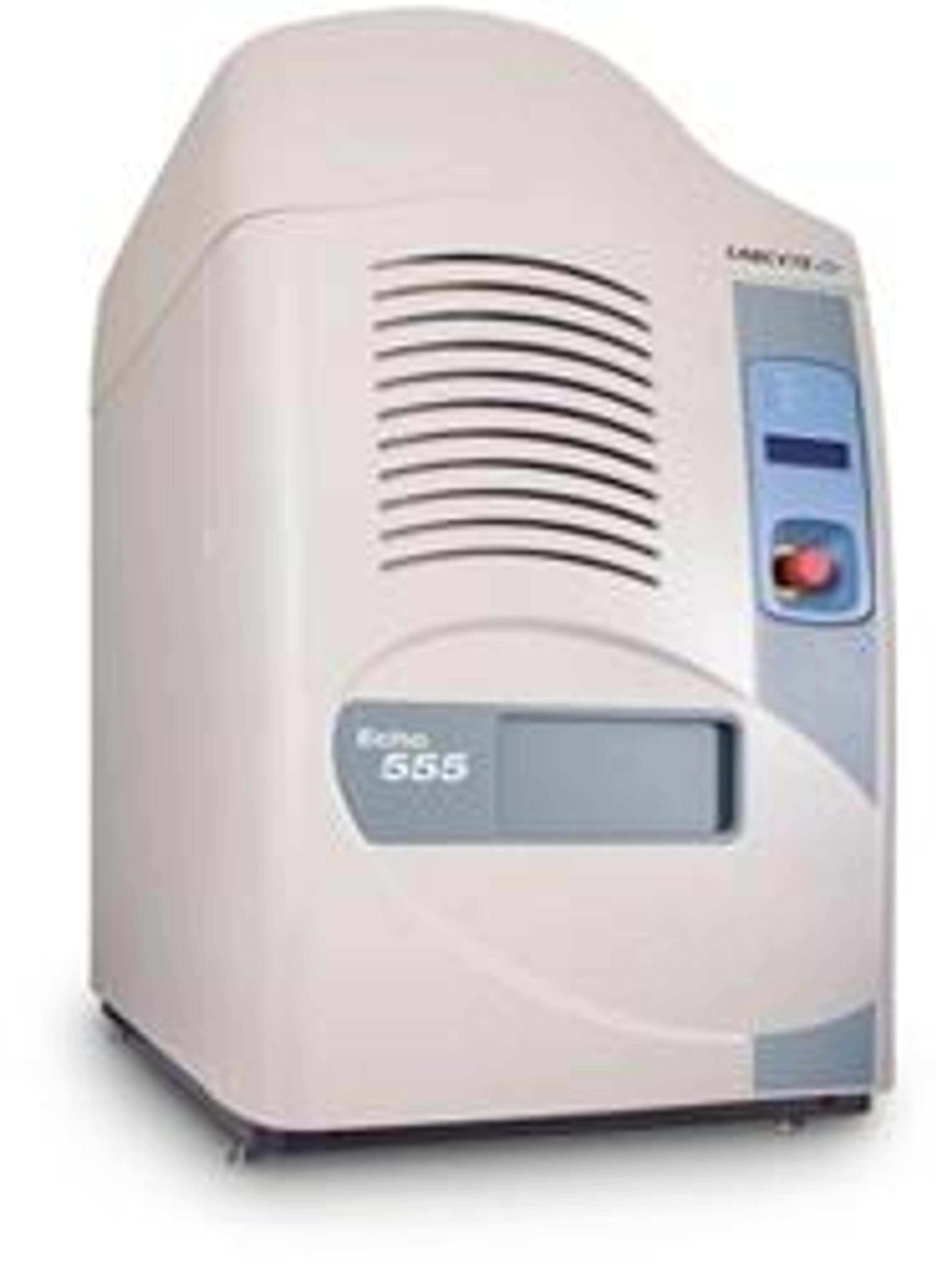
Echo® 555 Liquid Handler
Beckman Coulter Life SciencesEcho® 555 liquid handler - the world's fastest acoustic dispensing platform for life science applications. The Echo® 555 liquid handler is the world’s fastest acoustic liquid handling platform for life science applications. Laboratories that demand very high throughput rely upon the Echo 555 liquid handler for round-the-clock trouble-free operation to enable the fastest discovery.The Echo 555 doubles the throughput of the Echo 550 and provides transfers from as many as 660,000 wells per day. Like the Echo 520 and Echo 550 liquid handlers, the Echo 555 uses "touchless" ADE transfer technology. ADE uses sound energy to transfer 2.5 nL droplets from Echo-qualified 384- and 1536-well source plates into 96-, 384-, 1536- and 3456-well destination plates.This unique touchless technology eliminates consumable tip costs, washing, and cross-contamination. Unsurpassed volumetric precision (≤ 8% CV) and accuracy (≤ 10% CV) ensure superior results. Independent studies have shown that Echo liquid handlers eliminate false negatives due to sample loss on tip surfaces in low-concentration transfers. Like the Echo 550 liquid handler, the Echo 555 liquid handler reports both fluid volume and DMSO hydration.Echo® 555 Liquid Handler Features: Tipless transfer, resulting in dramatic cost savings Accurate, precise movement of nanoliter-scale quantities, enabling assay miniaturization and further reducing costs Elimination of cross-contamination, carryover or leachates Better results through direct dilution of compounds, an improvement over serial dilution methods Improved information about sample integrity and improved transfer quality through measurement of DMSO hydration level Applications: Compound management Compound screening siRNA screening Biochemical assays Cell-based assays PCR Genotyping Gene expression