
Acute Kidney Injury in Multiple Myeloma and Light Chain Deposition Disease
Professor Paul Cockwell addresses the delegation at the 7th International Binding Site Symposium
9 Sept 2015
Editorial article
Professor Paul Cockwell addressed the delegation at the 7th International Binding Site Symposium on Clinical Applications of Free Light Chain and Heavy/Light Chain AnalysisProfessor Paul Cockwell Paul Cockwell is a Consultant Nephrologist and Associate Director of Research at the University Hospital Birmingham and an Honorary Professor of Nephrology at the University of Birmingham, UK.
In his presentation, entitled Acute Kidney Injury (AKI) in Multiple Myeloma (MM) and Light Chain Deposition Disease, Professor Paul Cockwell began with a discussion of Chronic Kidney Disease (CKD) and AKI.
CKD is usually the result of a long-term disease that causes lasting damage to the kidneys over a prolonged period of time. A large proportion of the elderly population suffers from some form of CKD, and the damage caused to the kidneys is often irreparable. AKI occurs as a result of an event that quickly damages the kidney’s ability to function. AKI can occur as a consequence of Multiple Myeloma, and the damage can be reversible if diagnosed early on in its progression.
Approximately 50% of Multiple Myeloma patients present with a low glomerular filtration rate (GFR) and renal impairment. Picking up renal impairment alone is often a misdiagnosis of Multiple Myeloma. In these patients, as the serum FLC levels increase, the GFR decreases and the stage of AKI worsens.
Technological developments
AKI can be detected in a 24-hour urine test; however, this method is insensitive and slow. The Binding Site's Freelite® assay can be used instead for a faster and more sensitive method of detecting serum increases in FLCs. Rapid diagnosis of AKI is essential. Professor Cockwell described a number of studies that showed that if we identify FLC increase early on in its progression, and manage to reduce levels quickly, it is possible to not only avoid kidney dialysis, but also to significantly increase the survival time of patients.
Professor Cockwell noted that the current median survival of AKI patients following dialysis is good, although kidney function doesn't ever completely recover.
Professor Cockwell also highlighted, with the use of the graph shown below, that as our understanding of AKI improves, and with the development of diagnostic assays such as Freelite, the medium and long term patient survival times continue to improve year on year.
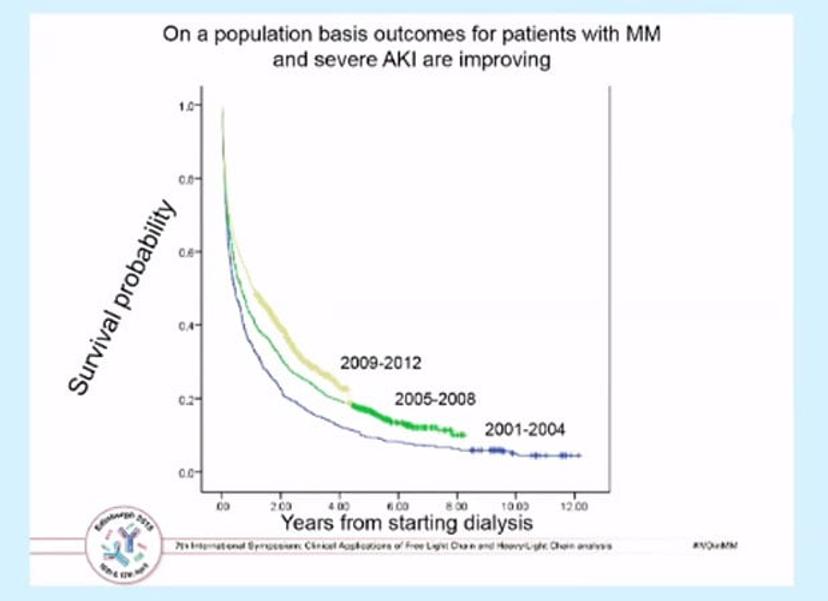
Graph showing the survival times of patients with AKI over the last fourteen years
The talk concluded with the acknowledgment that this is a very fast moving area of science. Our understanding of paraprotein-related kidney diseases (MGRS and MM) is rapidly evolving, and these developments are being driven by novel therapies and diagnostic developments, such as Freelite. As a result of this, patient outcomes are improving. Current focus in this area requires further development of the evidence base and generalization of best practice.
Watch Professor Cockwell's full presentation here.