Acoustic Dispensing for High Throughput Single Cell Sequencing Workflows

Improving RNA single cell genomics and sequencing library preparation protocols

9 Apr 2017
Mia Harley
Biochemist

Editorial article

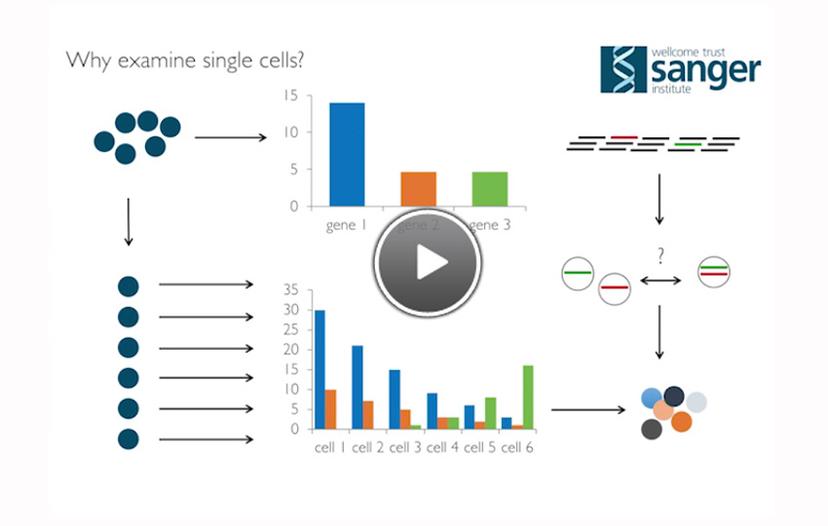
A slide from Dr. Stepham Lorenz's presentation for Labcyte Genomics Symposium 2016

The Wellcome Trust Sanger Institute The Wellcome Trust Sanger Institute is one of the premier centers of genomic discovery and understanding in the world. The Institute is part of the Wellcome Genome Campus located in Cambridge, UK. The Single Cell Genomics Core Facility there provides a transcriptome, genome and methylome sequencing service to the Wellcome Sanger Facility and their collaborators. 

Dr. Stephan Lorenz, Head of the Single Cell Genomics Core Facility at the Wellcome Trust Sanger Institute, UK was filmed speaking at the Labcyte Genomics Symposium. Dr. Lorenz explains the importance of single cell analysis versus cell population studies for obtaining better discrimination of individual gene expression within a population. In this way, it is possible to answer questions that bulk cell population methods are not able to discern.

Dr. Lorenz provides an overview of the workflows used at the facility for isolating cells, amplifying RNA and DNA, library preparation and sequencing. He discusses cell capture including laser capture from tissue, cell dissociation and cell sorting. Dr Lorenz focuses on RNA sequencing for single cell genomics, in particular library preparation protocols.

The technology is showcased using a mouse embryonic stem cell study that investigated the subpopulation structure and the effects of different induced cell differentiation and pluripotency stages on the heterogeneity of gene expression. Dr. Lorenz illustrates how single cell transcriptome sequencing increases the resolution and enables cycling of cells between distinct developmental subpopulations to be observed. In contrast, an average reading of the population will not differentiate between the different cell states within a sample.

Streamlining RNA library construction

Focusing primarily on RNA, Dr. Lorenz describes, in detail, standard library construction steps and how they have streamlined them to increase productivity. After isolating cells into 96- or 384-well plates, reverse transcription of single cell RNA and amplification is carried out. This is followed by clean-up and then library construction, converting cDNA into sequencing ready libraries. A template switching, Smart-seq protocol is used at the core facility that produces amplified sequences with universal handles incorporated at either end. Dr. Lorenz describes how they have incorporated semi-automated liquid handling reverse transcription that is rapid, RNAse free easy-to-use and incorporates cDNA quality control (QC) monitoring.

Automated solid phase reversible immobilization (SPRI) clean-up is followed by sample transfer using Labcyte Echo liquid handling and Access systems for quantification, normalization and library construction.

Dr. Lorenz presents data demonstrating how acoustic liquid handling reliably transfers DNA with wide ranging sizes and concentrations. He also describes how the technology can routinely quantify eight 384-well plates, in one run with standards and normalization.

The Nextera method for DNA sample preparation

The Nextera method employed at the facility is described. This method involves DNA fragmentation, with addition of a small overhang using transposases, so PCRs can be run with an adapter and primer against the overhangs, which introduces barcodes and flow cell adapters.

Selected for speed, Dr. Lorenz describes how the Nextera protocols have been adapted for the Echo and miniaturized to eliminate issues of high tip consumption and high cost per sample, whilst maintaining the same performance quality. The team are currently extending this to accommodate a 1536-well plate format.

The final stages of library construction prior to sequencing are described, in particular library QC using BioAnalyser qPCR that has been simplified using acoustic liquid handling, to reduce reaction volumes 10-fold, and save time and consumables by further using a simulated serial dilution.

Watch the full presentation or learn more about the Echo® 525 Liquid Handler
 

Leave a product review today to be entered into a prize draw for the chance to win an iPad or $400 Amazon voucher (or equivalent currency)

Links

Tags

PCR and Thermal CyclingPolymerase chain reaction (PCR) kits and thermal cyclers are used for the in vitro amplification of DNA permitting subsequent analysis and experimental procedures. Explore a range of high-quality polymerase, primers and nucleotides or simplify your workflow with a PCR mastermix. Find reverse transcription PCR (RT-PCR) and cDNA synthesis kits for RNA products and libraries. Quantitatively measure the amplification of DNA with real-time PCR (qPCR) and droplet digital PCR (ddPCR) kits and systems, and discover automated PCR setup solutions to increase throughput. Alternative DNA amplification methods also include recombinase polymerase amplification (RPA) kits. Find the best PCR kits and thermal cyclers and purification equipment in our peer-reviewed product directory: compare products, check customer reviews and receive pricing direct from manufacturers.DNA / RNA Extraction and PurificationPurified DNA and RNA are required for numerous downstream molecular biology applications. Consequently, the importance of high-quality DNA/RNA extraction and purification equipment cannot be underestimated. Many purification kits are available and are typically optimized for nucleic acid type and source, including plasmid DNA, genomic DNA, mRNA, RNA and viral nucleic acid purification kits. Automated extraction and purification of nucleic acids can be implemented with magnetic bead separator instruments or high-throughput purification workstations. Find the best DNA/RNA extraction and purification equipment in our peer-reviewed product directory: compare products, check customer reviews and receive pricing direct from manufacturers.DNA SequencingDNA sequencing, such as sanger sequencing, is a biological technique that determines the precise order of nucleotide bases in a fragment or template of DNA. DNA sequencers and genetic analyzers are based on capillary electrophoresis, where labeled DNA fragments are electrophoretically separated by size as they migrate through a polymer. Find the best DNA sequencing products, including DNA sequencing kits, genomic libraries and genetic identity kits in our peer-reviewed product directory: compare products, check customer reviews and receive pricing direct from manufacturers.Gene Expression and Molecular CloningMolecular cloning is a set of techniques that utilizes vectors to transfer recombinant DNA into host cells and is an essential tool for investigating the expression of genes and proteins in bacterial or mammalian cells. A variety of vectors optimized for gene cloning and expression in a range of host organisms are available, alongside competent cells for genetic replication. Here, you can explore a range of molecular tools, high-quality genomic and cDNA libraries, premade clones, transformation and transfection reagents and mutagenesis or gene expression detection assays and expression arrays. Find the best gene expression and molecular cloning products in our peer-reviewed product directory: compare products, check customer reviews and receive pricing direct from manufacturers.Clinical GeneticsMolecular Genetics covers the analysis of hereditary genetic disease and chromosomal abnormalities. Genetics can be analysed using DNA, RNA, and protein microarrays, PCR, RT PCR and DNA sequencing. Genetic equipment includes genetic workstations, thermal cyclers, cooling blocks and electrophoresis products. Diagnostic kits are used for DNA / RNA extraction and purification.Next Generation SequencingNext-generation sequencing (NGS), also known as whole-genome sequencing, high-throughput sequencing and massive parallel sequencing, produces and analyses thousands to millions of nucleotide sequences at once. Sequencing systems operate via varying technologies depending on the manufacturer, including sequencing by synthesis, ligation, pyrosequencing, ion semiconductor and single-molecule real-time sequencing. For NGS, library preparation is paramount to successful sequencing. In this section, explore a range of library preparation kits, from targeted, amplicon-based or hybridization-based kits including epigenomic, transcriptomic and genomic workflows to fragmentation kits. Find the best next-generation sequencing products in our peer-reviewed product directory: compare products, check customer reviews and receive pricing direct from manufacturers.Library PreparationLibrary preparation is a critical step in sequencing workflows, where DNA or RNA samples are converted into libraries for high-throughput, next generation sequencing. This step ensures accurate results and minimizes biases. Explore library preparation kits in our peer-reviewed product directory; compare products, check reviews, and get pricing directly from manufacturers.DNA AmplificationDNA Amplification is a technique used to amplify a single or multiple copies of DNA or mRNA by orders of magnitude. The most common method employed is PCR, but other options exist that eliminate the need for thermocycling.Single Cell GenomicsRNA-SeqRNA sequencing (RNA-seq) is a next-generation sequencing technique used to analyze the transcriptome, providing insights into gene expression and regulation. This method is essential for genomics, disease research, and personalized medicine. Explore RNA-seq tools in our peer-reviewed product directory; compare products, check reviews, and get pricing directly from manufacturers.