Absolute Quantification of Protein and RNA in a Single Cell Using Digital PCR Technology

Read About the Pioneering Technique Published in Molecular Cell

1 Mar 2017

Lynsey Forsyth
Post Doc / Research Fellow

Editorial article

Dr Cem Albayrak, Assistant Professor of Chemical and Biological Engineering, College of Engineering, Koç University, spoke to SelectScience® about his research, which developed a powerful, novel methodology for the absolute quantification of messenger RNA (mRNA) and protein expression in single cells, using droplet digital PCR (ddPCR).
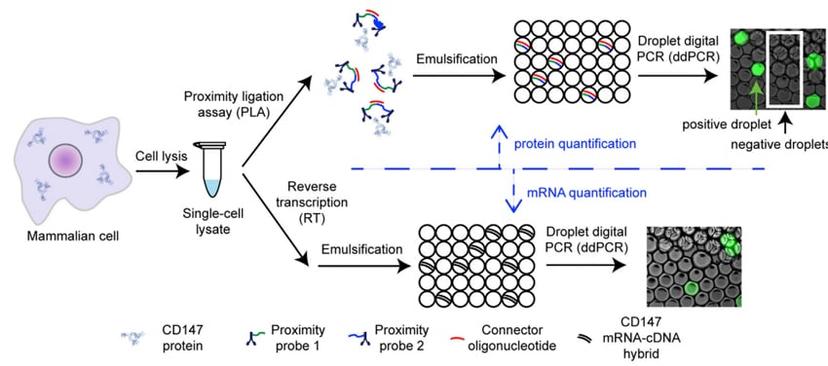
The Digital PLA Procedure schematic (Courtesy of Dr Albayrak). 

The method was recently published by Dr Albayrak and colleagues in Molecular Cell (DOI: 10.1016/j.molcel.2016.02.030). Dr Albayrak completed the work as a postdoctoral researcher at the Department of Biosystems Science and Engineering (D-BSSE) at ETH Zürich in Switzerland. The work focused on the use of microfluidics and biochemistry to accurately quantify protein and RNA from single cells. The team combined droplet digital PCR technology with proximity ligation assay (PLA) to facilitate absolute quantification of both mRNA and protein in a single cell. The method, known as digital PLA, used standard digital PCR procedures combined with PLA.

Advantages of combining the methodologies

PLA is an immunoassay that enables high resolution and sensitive detection of proteins in situ. Different epitopes on the protein of interest are recognized by primary antibodies that are conjugated to short DNA probe sequences. When two antibodies bind their epitopes on the same target protein, the probe sequences come in close proximity and interact with connector DNA oligonucleotides. The strands can then be amplified using digital PCR to facilitate detection of the protein of interest.

Droplet digital PCR is a technology that enables the detection and quantification of very low levels of DNA or RNA. A sample is partitioned into nano-liter sized droplets and target DNA amplification is performed within each droplet using specific primers and fluorescently labelled probes. Fluorescent droplets are scored as positive for the target sequence, whilst droplets lacking fluorescence are scored as negative, which provides an absolute quantification of target DNA within the sample. By applying the ddPCR principle to the protein-antibody-conjugates, precise protein quantification was made possible from a single cell. mRNA levels from the same cell were also quantified using ddPCR, as indicated in the digital PLA schematic above.

In the published study, Dr Albayrak and his colleagues demonstrated that digital PLA was extremely sensitive in the absolute quantification of CD147 protein and its corresponding mRNA. The power of this type of dataset could enable researchers to model transcription and translation mechanisms in a single cell, and would be sensitive enough to detect low concentration changes in response to changing conditions.

Future applications

The use of the new digital PLA methodology has significant implications for the future of diagnostics. The remarkable sensitivity of the technique will allow minuscule concentrations of biomarkers to be detected. In addition, it would be possible to look at biomarkers in real-time, as compared to current methodologies, which can analyze end-point measures. The technique could also be applied to primary cells taken from patients and has many possible applications in precision medicine. However, there are still some limitations. Detection of proteins is limited by the availability of suitable antibodies and the technique is not yet sufficiently developed to enable multiplexing.

Dr Albayrak and his colleagues have developed an accessible assay that can precisely quantify mRNA and protein in the same sample using readily available and inexpensive methodologies.

Access the full research article here to learn more about this cutting-edge technique. Find out more about ddPCR in this video.

Links

Tags

AntibodiesAntibodies are used in techniques such as confocal and fluorescence microscopy, flow cytometry, ELISA, ELISPOT, immunohistochemistry, western blotting and immunopreciptation. Select specific antigen reactivity, high specific affinity, low non-specific binding, monoclonal or polyclonal, primary or secondary antibodies and associated conjugates such as an enzyme or dye for visualization.PCR and Thermal CyclingPolymerase chain reaction (PCR) kits and thermal cyclers are used for the in vitro amplification of DNA permitting subsequent analysis and experimental procedures. Explore a range of high-quality polymerase, primers and nucleotides or simplify your workflow with a PCR mastermix. Find reverse transcription PCR (RT-PCR) and cDNA synthesis kits for RNA products and libraries. Quantitatively measure the amplification of DNA with real-time PCR (qPCR) and droplet digital PCR (ddPCR) kits and systems, and discover automated PCR setup solutions to increase throughput. Alternative DNA amplification methods also include recombinase polymerase amplification (RPA) kits. Find the best PCR kits and thermal cyclers and purification equipment in our peer-reviewed product directory: compare products, check customer reviews and receive pricing direct from manufacturers.DNA / RNA Extraction and PurificationPurified DNA and RNA are required for numerous downstream molecular biology applications. Consequently, the importance of high-quality DNA/RNA extraction and purification equipment cannot be underestimated. Many purification kits are available and are typically optimized for nucleic acid type and source, including plasmid DNA, genomic DNA, mRNA, RNA and viral nucleic acid purification kits. Automated extraction and purification of nucleic acids can be implemented with magnetic bead separator instruments or high-throughput purification workstations. Find the best DNA/RNA extraction and purification equipment in our peer-reviewed product directory: compare products, check customer reviews and receive pricing direct from manufacturers.Protein PurificationProtein purification is a vital step in drug discovery, therapeutics, biotech and life science research. The purification process typically involves subcellular or membrane protein extraction with cell lysis kits, separation of proteins from cell debris by filtration or spin columns, and the isolation of proteins of interest from other proteins and impurities with affinity purification (including fusion protein tags and antibody binding proteins A, G and L), immunoprecipitation or chromatographic methods, such as ion exchange, size exclusion and immobilized metal affinity chromatography. All purification methods come in multiple formats for your laboratory needs, including agarose or magnetic beads, resins, columns and filter plates. Find the best protein purification equipment in our peer-reviewed product directory: compare products, check customer reviews and receive pricing direct from manufacturers.Gene Expression and Molecular CloningMolecular cloning is a set of techniques that utilizes vectors to transfer recombinant DNA into host cells and is an essential tool for investigating the expression of genes and proteins in bacterial or mammalian cells. A variety of vectors optimized for gene cloning and expression in a range of host organisms are available, alongside competent cells for genetic replication. Here, you can explore a range of molecular tools, high-quality genomic and cDNA libraries, premade clones, transformation and transfection reagents and mutagenesis or gene expression detection assays and expression arrays. Find the best gene expression and molecular cloning products in our peer-reviewed product directory: compare products, check customer reviews and receive pricing direct from manufacturers.BiomarkersBiomarkers are biological markers which can be measured and evaluated to indicate a biological state. The use of biomarkers in research and diagnosis can indicate a normal or disease state or drug response of cells / tissues. Biomarkers include genetic markers, cell surface markers such as antigens, antibodies or receptors and secreted molecules such as cytokines. An assay system is required for identification of biomarkers. :Protein QuantificationThe detection and quantification of proteins in a sample is vital across life sciences, pharmaceutical research and clinical diagnostics, and a variety of equipment is available to scientists to simplify the workflow. Proteins of interest can be easily labeled and detected on light-based detection instruments. Immunoassay kits allow you to identify a specific protein of interest and protein detection beads or antibody microarrays allow you to identify multiple specific proteins at once. Protein interactions and enzyme activity can also be monitored with protein-protein interaction assays. Additionally, the biophysical characterization of proteins is made easy with biokinetic analyzers. Find the best protein detection and quantification products in our peer-reviewed product directory: compare products, check customer reviews and receive pricing direct from manufacturers.Droplet Digital PCRDroplet digital PCR (ddPCR) is a method of quantitative PCR that partitions a sample into droplets, allowing precise detection of low-abundance targets. It is commonly used in gene expression analysis and mutation detection. Explore ddPCR systems in our peer-reviewed product directory; compare products, check reviews, and get pricing directly from manufacturers.Monoclonal AntibodiesMonoclonal antibodies (mAbs) are lab-made molecules that can bind to specific antigens on cells, making them highly effective in treating cancers, autoimmune diseases, and infections. These targeted therapies are transforming the treatment landscape for many conditions. Browse our peer-reviewed product directory to find monoclonal antibodies for research and clinical applications; compare products, check reviews, and get pricing directly from manufacturers.Protein ExpressionGene ExpressionSingle Cell AnalysisSingle-cell analysis involves studying individual cells to gain insights into their behavior, gene expression, and function. This approach is valuable in cancer research, stem cell biology, and immunology. Explore single-cell analysis products in our peer-reviewed product directory; compare products, check reviews, and get pricing directly from manufacturers.Single Cell Genomics
Absolute Quantification of Protein and RNA in a Single Cell Using Digital PCR Technology