
A new solution for compact and automated cell incubation
INHECO presents new options for liquid-handling workflows
10 May 2020
Product news
Incubation as a standardized laboratory process
A laboratory’s fundamental procedure is the process of incubation, with the objective of getting bio-chemical reactions regulated. In the cell-incubation process, temperature, the atmosphere of gas and relative humidity need to be controlled. Human cell culturing demands a temperature accuracy of +/-37°C and a CO2 ratio between +/- 5 %. Cell cultures evolve in a nutrient solution, it is crucial to maintain the water content within the solution. In order to minimize water loss within the nutrient solution the relative humidity needs to be increased and maintained at a level towards the maximum degree of saturation. All other environmental influences caused by light, draft, dust and aerosol particles need to be eliminated.
An incubator addresses all the requirements within its enclosed, tempered, moistened and aerated chamber, where disposables carrying cell cultures in nutrient solutions can be stored. For manual process runs, incubators have been established in the market for a long time and you can find lots of variants in terms of size and loading capacity. However, in automated laboratories the only products currently available are targeted towards high-throughput applications from ~40 to several thousand Microwell plate positions. Until recently, for automated cell experiments requiring a smaller amount of plates there was no suitable solution available.
A new solution for automated incubation
The INHECO SCILA CO2 MP-4 had been purpose-designed to address this requirement - for automated cell-based assays with a maximum of 4, 8 or 12 microplates, for workflows on liquid-handling platforms.
The SCILA incubator is a compact instrument, its optimized footprint designed to enable the incubator to be easily be placed next to the deck of a liquid-handling platform.
The device offers incubation positions for 4 SLAS ANSI microwell plates. Each tray position can be individually retooled for a huge variety of plates with heights ranging from 20 mm up to a maximum of 23 mm.
The SCILA is a drawer-based solution, the 4 trays can be individually opened for loading and unloading.
The operating temperature range starts at 5 Kelvin above ambient up to 45°C. CO2 concentration can be varied from 5 to 10 percent. Relative humidity is set and guaranteed at values ranging between 95% and 100% - provided by a water level at the bottom of incubation chamber. The incubation chamber itself is made of copper.
The SCILA has been developed with rapid and seamless integration in mind – it fully complies with the SiLA1 communication standard.
Temperature uniformity and temperature recovery
An automated workflow processes multiple samples in parallel. Ideally, all samples need to be processed under identical, pre-determined parameters and conditions. The SCILA Incubator enables users to set and receive uniform process parameters for all plate positions and samples – At a target temperature of +37°C the maximum temperature difference across a single plate is 0.3 Kelvin and the maximum difference in temperature between the top and bottom drawer is 1 Kelvin.
The process of opening a drawer for loading and reloading temporarily introduces ambient air into the incubator, consequentially the internal incubation parameters get affected. The SCILA is designed to minimize the impact of that interference.
At an internal temperature of 37°C, even if all 4 drawers are opened one after the other for a period of 10 seconds each, the temperature reduces by less than 1 Kelvin. The incubator continues to remain with specified tolerance of ±1 Kelvin – regardless of whether any trays are empty or loaded. Please also see detailed information in this application note.
Easy cleaning and maintenance
The SCILA incubator was designed with easy and simple cleaning in mind, all core components can be quickly removed and cleaned without using tools.
The process of disassembly and cleaning can be completed rapidly and entirely by hand - the drawers can be removed by pushing a securing clip, the front panel is fixed by magnets for easy removal and the sample tray can also be unmounted by hand.
In order to minimize any chance of contamination, a patented drawer construction means that only the sample carrier and the inner side of the drawer door are in contact with the incubation chamber. Furthermore, guide rails and drive mechanism are located outside of the incubation chamber, further reducing any impact or risk of contamination.
Once everything has been removed, the copper incubation chamber is free and completely accessible - it is a smooth chamber with no sharp or inaccessible areas. It can be cleaned and disinfected using soap water and subsequent wiping of Ethanol (70%).
Conclusion
The SCILA CO2 MP-4 is a unique and innovative product that provides an economical solution for the processing of up to 4 cell culture plates in an automated workflow on a liquid handling platform. It can be rapidly and simply scaled up from 4 to 8,12 or 16 plates by processing several incubators in parallel.
The product enables consistent high-quality processing of plates with simple standardized integration and effortless servicing and cleaning.
Do you use INHECO products in your lab? Write a review today for your chance to win a $400 Amazon Gift Card>>
Related products
Request Quote for All Products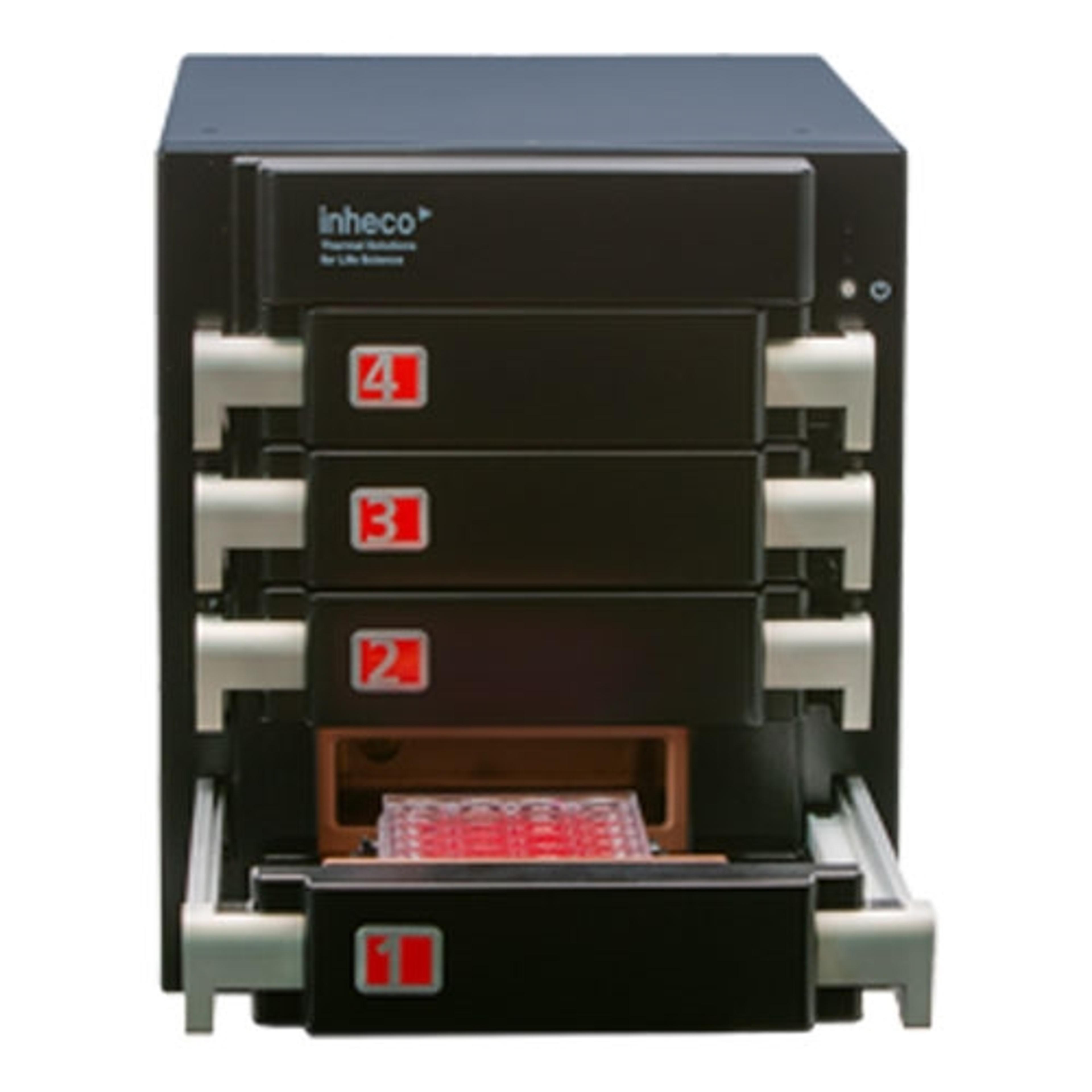
SCILA CO2 4-Position cell incubator
INHECO GmbHMaximum variability of cell incubation parameters in minimal space on your deck