A new paradigm in forensic drugs analysis labs: Near-instant results with high specificity
Eurofins’ Ryan Francis discusses the development of new ambient mass spectrometry instrumentation to accelerate drug testing services
4 Nov 2020
Editorial article
Eurofins is an advanced analytical service provider that promises a comprehensive range of independent and innovative testing solutions to a range of industries. Alongside its food quality, environmental monitoring, and biopharma services, Eurofins is the UK’s biggest provider of forensic services, offering testing solutions to police forces and legal and criminal justice organizations throughout the UK and Europe.
In this exclusive SelectScience interview, we speak with instrument specialist Ryan Francis about his work in the dynamic field of drugs analysis and his efforts, alongside industry leaders such as Waters and LGC, to reshape standard techniques and operating procedures.
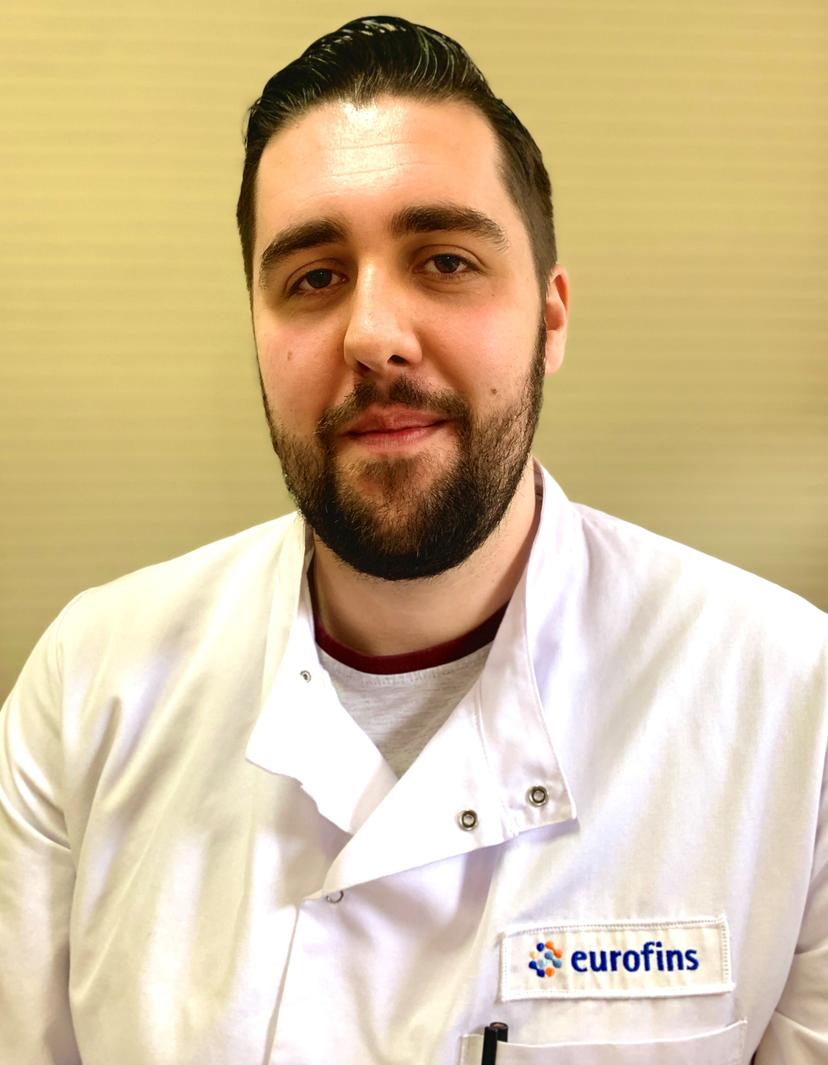
“We are heavily reliant on instrumentation in our laboratory, with hundreds of samples and large amounts of potential sample compositions needing to be analyzed at any one time,” explains Ryan. “I’m responsible for coordinating the use of our instrumentation and looking at the way in which we refine and adapt our methods based around that instrumentation, to stay at the cutting edge in the ever-changing field of forensic science.”
Forensic analysis to court proceedings
"The difference between a guilty or innocent verdict"
The team at Eurofins works very closely with police forces to facilitate and assist the criminal justice system and the way it functions. However, Ryan admits that he rarely sees the inside of a courtroom: “As a drugs expert, we don't tend to go to court as much because our evidence is quite categoric, but our reports could be the difference between a guilty or innocent verdict, so ensuring quality is of paramount importance.”
Working with police around the UK, as well as European and international forces, Eurofins provides both immediate and routine services, focused on delivering timely identification and the classification of seized drugs. The various forces seize a large number of drugs daily that require a quick turnaround time. For example, if someone is in police custody, rapid analysis is needed to either charge or release them - the custody clock approach - or, if there are bail concerns or the need for intelligence-based identification.
“We produce streamlined forensic reports (SFR), and full traditionally signed statements, that are given to the police,” Ryan explains. “If they've seized what we believe to be drugs and we provide a report that confirms or denies that we've identified drugs, this influences their investigation and, if those reports are then followed up with the Crown Prosecution Service (CPS) who make the decision to take a case to court, they influence the jury verdict and the sentencing decisions from the judge.”
Beta-testing from a working lab
"A robust tool for categoric identification and screening"
In the field of drugs analysis, Ryan notes the huge variety of substances encountered on a day-to-day basis: “When receiving a sample, it could be anything from something herbal and natural, like cannabis or mushrooms, to something totally synthetic, like methamphetamine, or even something in between, like cocaine. So, we need different ways of analyzing these various substances in their various forms, be it powder, tablet, or something different.”
To start, labs predominantly use spot or color testing, which provides an indicative reaction to give early indications of a samples identification and inform further analysis, if required. Color change tests are reliable, cheap, and simple to use, but certain pharmaceuticals can have very little active component, and therefore can't be reliably screened by spot test.
Luckily, forensic analysts have a plethora of techniques to achieve robust identification and quantification. Ryan highlights Fourier-transform infrared spectroscopy (FTIR) for the identification of powders, gas chromatography-mass spectrometry (GC-MS) for discriminating mixtures of different substances, high-performance liquid chromatography (HPLC) for determining purity and quantitative work, and gas chromatography with flame-ionization detection (GC-FID) for quantification of certain compounds. The team also uses more specialized techniques such as thin-layer chromatography (TLC), which helps address complex samples. However, such techniques can be expensive, time-consuming, and require extra equipment, such as fumehoods, for safe execution.
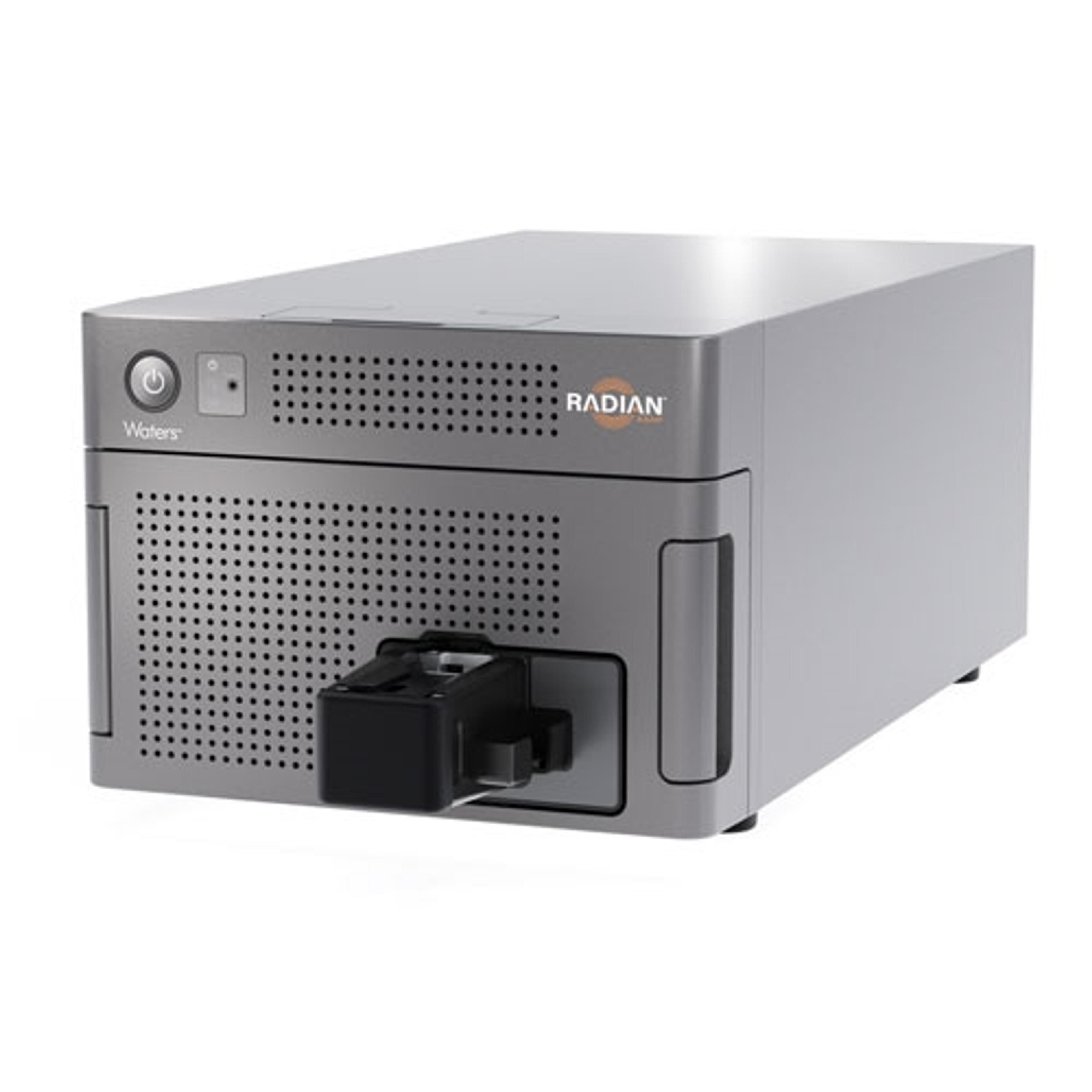
“We were invited to work collaboratively with Waters and LGC to help test and facilitate the development of a new ambient mass spectrometry (AMS) system, in the hopes of adapting to the challenges in our existing methods,” says Ryan. “We worked with the beta model of the RADIAN ASAP and quickly found that it was a robust tool for categoric identification and screening of substances.”
The team first conducted rudimentary screening tests and found that the RADAIN ASAP provided very clear, concise data, even for those untrained in drugs analysis protocols. “We gave an independent analyst a few different samples to run on the new instrument, and he was almost immediately able to provide us with these results, as well as determining differences in visually identical samples” explains Ryan. “We then considered how often we conduct the screening and worked out just how much time we could potentially save.”
In addition to these “near-instant” results, the team noticed that the technique provided reliable identification of individual components within difficult-to-detect mixtures. “Originally, we expected that it wouldn’t reliably identify individual components in complex mixtures, as though it was an MS without GC,” recalls Ryan. “However, we ran multiple different samples and different preparations, and found that it could very reliably and consistently narrow down specific components and matched up with our existing GC-MS data.”
This capability fast became a key driver for getting the RADIAN ASAP into the Eurofin’s drugs lab and helping with casework delivery. “We were fortunate to be able to collaborate with Waters and help facilitate the development,” states Ryan. “We hope that this will help us change the way we work to deliver more efficiencies to the customers and more robust testing in line with our already high-quality standards.”
Collaboration, accreditation, and validation
"A machine for the future"
The strong reputation of Eurofins Forensics is rooted in its commitment to the advancement of its methods and instrumentation, achieved by rigorous internal quality review procedures. “We’re very pleased to work collaboratively with multinational instrument production and scientific companies, such as LGC and Waters,” explains Ryan. “This shows that Eurofins really is committed to improvement and development, both scientifically and in terms of our operating procedures.”
For an accredited forensic drugs lab, anything that is changed or added to the processes, methods, or instrumentation used must be clearly documented to ensure it adheres to regulated standards. “This can be quite a long process, but it's there for a reason,” explains Ryan. “What we do really matters in the criminal justice system, so it's part of our duty and responsibility to make sure that we implement it properly.”
Ryan notes that an instrument such as the RADIAN ASAP could be useful across the field of forensics, not just in drugs analysis, and Eurofins hopes to get the instrument and the AMS method accredited and validated for use in live casework: “We've got the latest model in the lab at the moment and, although we haven’t had it for long, we’re already pleased with it. Now, we are looking to prove that it is fit for purpose by ensuring certified reference materials give expected results.”
The data provided by this instrumentation aims to bridge the gap between FTIR, a fast technique with no separation power, and GC-MS, which is slower but has much stronger separation power. As for the RADIAN ASAP itself: “This is a very compact, nice looking machine that sits neatly on a desk, which really does show how far companies like waters and the scientific community as a whole are pushing the boat out to be able to deliver techniques that are both fit for purpose and reliable in their quality,” Ryan concludes. “They keep telling us it’s a machine for the future, and I’m inclined to agree.”
Find out more about how to optimize your analytical chemistry workflows with these expert resources: