3D Cell Culture in the Flask

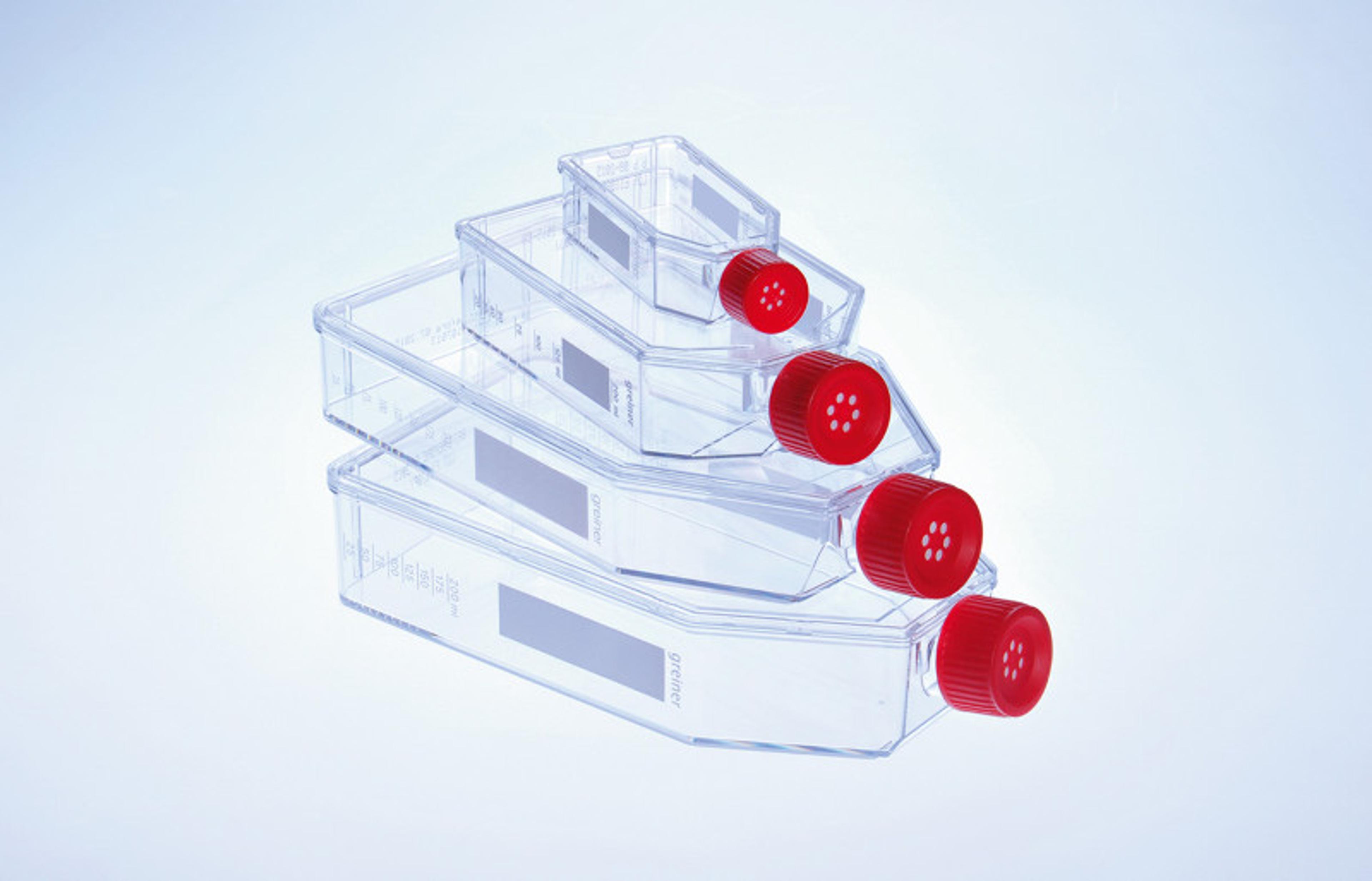
CELLSTAR cell culture vessels with cell-repellent surface available in new formats

19 Jun 2016
Alex Waite
Editorial Assistant

Product news

Greiner Bio-One, the technology partner to the diagnostic and pharmaceutical industry, exhibited its extended product portfolio of CELLSTAR cell culture vessels with cell-repellent coatings at the analytica 2016 trade fair, which was held from 10 to 13 May in Munich, Germany.

Previously, only cell culture plates and dishes were available with this unique surface. However, at the start of the year, Greiner Bio-One added cell culture flasks in three different formats (25 cm², 75 cm² and 175 cm² growth area) to its range, as both standard and filter-top cell culture flasks. The new tall 175 cm² flask rounds off the Greiner Bio-One product portfolio of cell culture flasks with cell-repellent surface.

Ideal platform for 3D cell culture

The CELLSTAR cell culture vessels with cell-repellent surface are ideal for cultivating cells to form three-dimensional structures. Outstanding results can be achieved, particularly when they are used with technology from cooperation partner Nano3D Biosciences, which is based in Houston, Texas, in the USA. This technology is based on the magnetization of cells using nanoparticles that attach themselves to the cell membrane. The development of three-dimensional spheroids or ring structures is initiated by briefly applying magnets.

As the CELLSTAR cell culture vessels with cell-repellent surface effectively prevent the adhesion of semi-adherent and adherent cell lines, they are ideal for suspension cultures and for cultivating spheroids, stem cell aggregates and gel-based 3D cultures.

All CELLSTAR cell culture vessels with cell-repellent surface are free of detectable DNases, RNases and human DNA. They contain no detectable endotoxins or cytotoxic substances, are sterile and have a shelf life of four years.

CELLSTAR® cell culture vessels with a cell-repellent surface are part of the CELLSTAR® product line from Greiner Bio-One.

Links

Tags

Cell Adhesion AssaysCell adhesion assays are used to quantitate attachment and analyze the molecular mechanisms for extracellular matrix adhesion, cell migration and sensitivity to inhibitors. Find the best cell adhesion assay equipment in our peer-reviewed product directory: compare products, check customer reviews and receive pricing direct from manufacturers.Cell / Tissue CultureCell culture or tissue culture is used to study the biology of cells or tissues and to isolate cellular products in an environment which can be manipulated and well defined. Accurately control your culture environment with bioreactors or culture incubators, bind your cells to a surface or together with an extracellular matrix. Distinguish cell types with differential media or proliferate cells with certain characteristics using selective media. Enrich your media with supplements such as growth factors, sera and vitamins. Find the best cell and tissue culture products, kits and equipment in our peer-reviewed product directory: compare products, check customer reviews and receive pricing direct from manufacturers.Cell Lines Stem Cells and Primary CellsPrimary cell cultures, established cell lines and stem cells are vital for <i>in vitro</i> and <i>ex vivo</i> experimentation. High-quality cells, optimized for your applications, alongside optimized cell substrates, growth medium and supplements, are critical for experimental success. Explore a range of cells suitable for your applications, including isogenic cell lines, competent cells, induced pluripotent stem cell (iPSC)-derived cell lines, fungal/bacterial/mammalian cell lines, stem cells and cancer cell lines. Find the best cells for your research in our peer-reviewed product directory: compare products, check customer reviews and receive pricing direct from manufacturers.IncubatorsLaboratory incubators are used to provide a stable environment to cultivate and store samples in, giving you optimal control of temperature, humidity, oxygen and CO<sub>2</sub> levels. Incubators are necessary equipment for cell culture and microbial research. Control temperature with heated or refrigerated incubators, or the levels of CO<sub>2</sub> and oxygen with CO<sub>2</sub> incubators. Using environmental chambers, create a humid climate for testing samples. Find the best incubators in our peer-reviewed product directory: compare products, check customer reviews and receive pricing direct from manufacturers.Labware and Lab SuppliesLabware and lab supplies include various forms of glassware, plasticware, reagents and personal protective equipment (PPE) and are used across all scientific laboratories, enabling daily tasks to be performed. Explore a range of flasks and beakers, petri dishes, carboys and storage bottles. Labware such as condensers, desiccators and burettes are also available for more specific tasks. Find the best labware and lab supplies in our peer-reviewed product directory: compare products, check customer reviews and receive pricing direct from manufacturers.Sample ManagementSample management systems include sample storage devices such as freezers and plate storers, sample environment enclosures and sample organization, retrieval and sorter systems. Useful system features include high-throughput, automation, robotic arms, automated liquid handling and associated database systems. Accessories in sample management include barcode scanners, heat sealers and tubes.Flow Cytometry / Cell CountingFlow cytometers are used to count, sort and examine multiple characteristics of cells. Other cell analysis equipment includes image cytometers, cell counters, fluorescence-activated cell sorters (FACS), magnetic-activated cell sorters (MACS), and a range of flow cytometry assay kits. Flow cytometers can reveal information on cell viability, cell proliferation, apoptosis and cell cycle progression, as well as identify cell populations and intracellular or cell-surface molecules. Additionally, some flow cytometers, known as FACS, have an additional sorting function after analysis. Cell counters and image cytometers count live and dead cell populations and can also conduct cell proliferation assays. Find the best flow cytometers, cell counters and cell sorters in our peer-reviewed product directory: compare products, check customer reviews and receive pricing direct from manufacturers.Cell-Based AssaysCell-based assays are used to monitor the presence, quantity and activities of a desired cellular analyte including drug molecules or biomarkers. This can reveal information on cell health (apoptosis, cytotoxicity, viability and proliferation assays), cell metabolism, cell migration and cell signaling mechanisms. Find the best cell-based assay products, kits and equipment with our peer reviewed product directory: compare products, check customer reviews and receiving pricing direct from manufacturers.Biopharmaceutical AdvancesBiopharmaceutical advances follow the development of pharmaceuticals derived from biotechnology, also known as biotechnology medicines. Biopharmaceuticals may be produced from cell lines, plants, or microbial cells. Important considerations of biopharmaceutical use include application, cost, production process and purification.Automated Liquid HandlingAutomated liquid handling equipment is used to mix, dilute and dispense allotted volumes of liquid into microplates and other vessels automatically. The robotic, liquid handling arms can dispense from single channel to 3456 multichannel as well as operate nanoliter dispensing, enabling high throughput of samples. Find the best automated liquid handlers in our peer-reviewed product directory: compare products, check customer reviews and receive pricing direct from manufacturers.In Vivo Imaging Systems<i>In vivo</i> imaging systems, including pre-clinical imaging systems and medical imaging systems are used to non-invasively visualize and capture images of live animals and plants. Monitor the natural processes or diseases of your subjects using small-animal pre-clinical imaging systems, including single photon positron emission tomography (SPECT), positron emission tomography (PET), computed tomography (micro-CT), magnetic resonance imaging (MRI), X-ray radiography, ultrasound, fluorescence and bioluminescence imagers. Multimodal systems and software solutions are also available for correlative analysis of organ, tissue, cell, or molecular-level processes. Find the best in vivo imaging products in our peer-reviewed product directory: compare products, check customer reviews and receive pricing direct from manufacturers.Cell AnalysisThe analysis of cells allows researchers to understand the factors which contribute to cell health and function. These influencing processes can then be predicted and altered, leading to the development of medication and disease treatments.analyticaAnalytica is a leading international trade fair for laboratory technology, analysis, and biotechnology, showcasing innovations and solutions in the scientific community. Stay updated with the latest trends and products in the industry. Stem Cell ResearchStem cells have the ability to produce identical daughter cells as well as progeny, which commit and differentiate. Stem cell research has exciting prospects of biomedical applications in cellular disease modeling, pharmaceutical screening, and regenerative medicine. Cell Adhesion
3D Cell Culture in the Flask